
CULTURE READS
The Better Choice: Handmade Products Over Mass-Produced Items
Two of the things that have massively shaped the modern era are automation and mass production. In this age, what remains appreciated for its authenticity are handmade products—they are slower to produce, often imperfect in appearance, and tied to the crafter behind them—that is precisely where their value lies. Handmade products are living records of tradition that hold techniques, stories, and identities that might otherwise fade over time. In the Philippines, this connection between craft and culture remains visible in both expected and surprising ways. Textiles, baskets, pottery, and even food continue to reflect regional identity. Each piece is not just about how it was made, but why it exists in the first place.
DATEAPRIL 20, 2026
AUTHORANGELA CLARE AGPAWA
READ10 Min

Handicrafts as a Form of Cultural Archive
While handmade goods are often referred to as expressions of creativity, they are just as much about preservation. Methods passed down through generations rarely exist in written form, but are rather taught through repetition. At the same time, handmade art pieces tell stories of tradition and culture itself, which explains the existence of museums. There are infinite other ways in which handmade crafts are relevant to preserving culture.
Endangerment does not only apply to animals or plants; it can also apply to crafts. Vacation With An Artist (VAWAA) listed some of the most endangered crafts in the world that survive only through the dedication of master artisans, including Sicilian Puppet Making, Appalachian Broom Making, and Japanese Umbrella Making.
In the Philippines, there are five vanishing crafts on the verge of extinction, one of them being Borlas de Pastillas or pastillas pabalat, the century-old paper-cutting art form used to wrap pastillas, an iconic Filipino childhood dessert.
Another is Pukpuk or Repoussé, an ancient metalworking technique involving hammering thin metal sheets from the reverse side to create a raised, three-dimensional relief design on the front. This craft dates back to the fourth century across multiple cultures, including the Philippines. Bryle Suralta, in a published article by the University of the Philippines Alumni, wrote, “Our Visayan ancestors were famous for repoussé. […]”
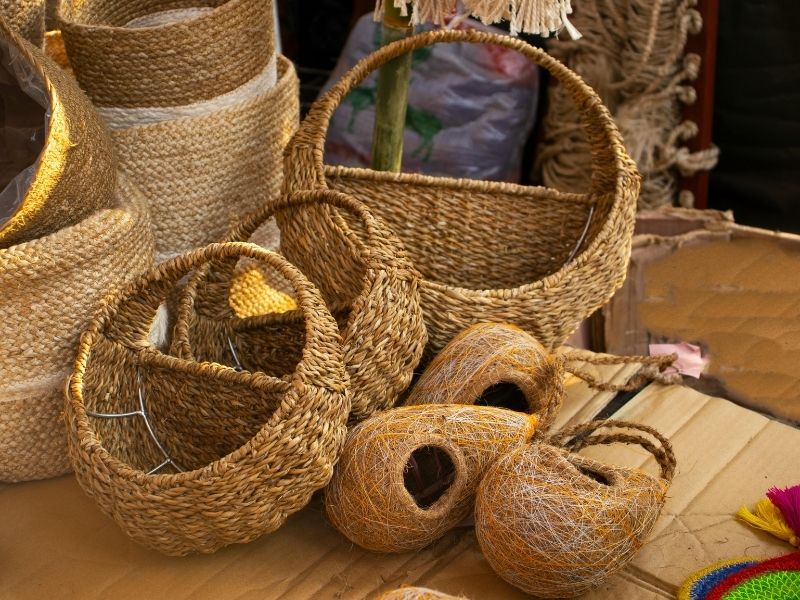
It would not be ideal for a culture-rich country like the Philippines to further risk losing a limb in its handicraft industry. This is the aspect in which handicraft businesses are most appreciated. Submit Labin Handicrafts and Daniel’s Handicraft are some of the most outstanding brands in the industry, offering woven baskets using various materials like rattan, bamboo, seagrass, pandan, buri, nito, and abaca.

Weaving is known as the primary cornerstone of Philippine handicrafts. While perishable, indigenous weaving is considered one of the country’s earliest crafts associated with pre-colonial culture. The Banton Burial Cloth (13th–14th century) is currently the oldest surviving woven textile in the Philippines.
Retailing authentic handwoven baskets and other forms of woven items helps cultural preservation in two main ways. By selling them, the art gains exposure to consumers and raises awareness about the rich weaving culture that many may have forgotten over the centuries. Massive handmade production also means large working communities that are capable of passing skills and keeping the tradition alive for generations to come.
In addition, this kind of commerce provides livelihood opportunities for many artisans. Daniel’s Handicraft does this by training in surrounding communities to create woven baskets using locally sourced materials. They also train inmates from the New Bilibid Prison—with this, learned skills have also become a bridge back into society, preserving not just culture, but dignity and purpose.
Cultural Preservation Through Food
Through food, we pass down recipes, techniques, and share meals among communities to maintain culture and social bonds. It’s a beautiful transformation of food from mere sustenance into a living memory that protects diverse global culinary identities.
As Chef Jay Reifel, author of History of the World in Ten Dinners, put it: “There’s no better way to connect people to their own history than giving them the immediacy of a dish in front of them.”
The Philippines’ most popular dishes reflect exactly what the culture is like. Adobo, sinigang, lechon, sisig, halo-halo—all are oddly simple, yet surprisingly and addictively rich. When food is nurtured, it improves and takes on multiple unique forms that further its potential. CMV Txokolat saw this and came up with kare-kare chocolate, adobo chocolate, bibingka chocolate, and sisig chocolate. The brand reimagines local cuisine in the form of handcrafted chocolate.

This idea of fusing a conventional chocolate with unique Filipino cuisines is something that can only be thought of if appreciated enough. This isn’t something that can be made with machines, but rather only truly done with heart and skills—the presence of a maker.
This human element is particularly significant in cultural preservation. When artisans create, they do not simply replicate designs; they interpret them. A basket may follow a traditional pattern, but subtle differences prove being made with the weaver’s hand. These variations are not flaws, but are proof that culture is alive.
Culture is often spoken of as something to protect, as if it were fragile and static. But in reality, they preserve, but they also transform. They honor tradition while making space for new interpretations. A chocolate bar inspired by Filipino cuisine introduces heritage in a form that feels entirely new.
That is the real role of handmade goods in cultural preservation. They do not freeze culture in place. Instead, they keep it moving, ensuring that stories, skills, and identities continue to be passed on, not as relics of the past, but as part of life.
Subscribe to Our Market for more culture reads.
