
Culture Reads
English-only Policy: Good or Bad?
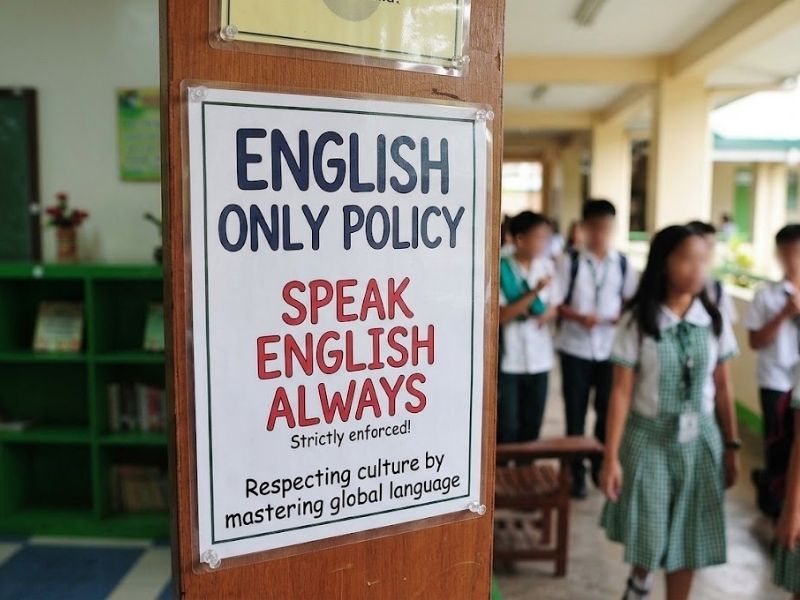
The English-only policy has been used by educational institutions as a way to increase students' exposure to the English language and encourage regular practice. At the same time, the policy has prompted discussion among educators and language advocates about communication, student confidence, and the role of Filipino and other Philippine languages in education.
The subject is particularly relevant during Buwan ng Wika (National Language Month of the Philippines), when attention turns toward the country's languages and linguistic heritage.
But the discussion around English-only policies did not begin with Buwan ng Wika. It is connected to more than a century of language policy, education, and the role of English in Philippine society.
DATEAugust 28, 2026
AUTHORANGELA CLARE AGPAWA
READ5 Min

Why English became so important in the Philippines
The Philippines' strong connection with English has historical roots, beginning during the American colonial period when English was established in Philippine public education.
The Yale Review of International Studies traces the development of an English-based public-school system to the early 1900s, when English was introduced as the primary language of instruction.
The role continued after the Philippines gained independence.
English became widely used in higher education, government, business, science, media, and professional communication. It also became highly relevant to industries that regularly communicate with international clients and organizations.
As a result, English proficiency has become an important educational and employment skill for many Filipinos. They think that it is one of the, if not the ultimate, keys to economic success.
This long-standing role helps explain why schools continue to place significant emphasis on English.

The argument for “English only”
One of the main reasons for implementing an English-only policy is increased exposure.When students speak English regularly, they have more opportunities to practice speaking, listening, vocabulary, pronunciation, and sentence construction outside formal English lessons.
A study published in the Philippine EJournals portal found that an English-only policy in the classroom improved students' communication skills, enhanced their English knowledge, and boosted their speaking confidence. Teachers also reported benefits involving instruction and classroom engagement.
The English-only policy is seen as an effective approach and learning strategy to create an environment where English is regularly spoken in order to develop students’ English communication skills.
Beyond the school, English proficiency can also have practical applications. It is commonly used in Philippine universities and professional environments, particularly in industries involving international communication.
But what happens when English becomes the only option?
The same Philippine E-Journals study that identified the benefits of English-only policy also documented communication difficulties, policy violations, and decreased self-confidence among students.A major downside is that it creates a point of partiality because students’ level of English proficiency can differ considerably. Those who are still developing their skills may have a hard time participating in discussions or communicating their ideas.

There is a distinction between encouraging English practice and requiring English in every interaction, therefore reinforcing the need for more regulated ways of implementing how the policy is experienced.
Some institutions may apply English-only rules to specific activities or classes, while others extend them to general conversations and official interactions across campus.
The cruciality of looking into these challenges has recently been exemplified by a controversy surrounding the Pamantasan ng Cabuyao (PNC) in Laguna, which received backlash after announcing its English-only policy. The announcement mandated all transactions, classes, and interactions on campus to be “conducted exclusively in English, both in written and spoken communication,” drawing viral criticism calling the rule overly restrictive, counterproductive, and harmful to native language use and cultural identity—which is a separate, and even bigger, disadvantage of the English-only policy surrounding this discussion.
According to the Philippine Star, the school later clarified that the rule is a "limited engagement" meant for official business, meetings, and transactions, and does not penalize informal or unofficial peer-to-peer conversations and chit-chat among friends.
This kind of English-only policy is more forgiving, especially for objectors
Related:The Story of Buwan ng Wika
The Philippines isn't just bilingual
English and Filipino are the Philippines' two official languages, but they represent only part of the country's linguistic landscape.The country is home to numerous regional and indigenous languages, many of which continue to be used in homes and communities.
This multilingual environment adds another dimension to the discussion surrounding English-only policies.
The Yale Review of International Studies has raised concerns about the declining use of some Philippine languages and the possibility of language extinction. Its discussion examines how the long-standing prominence of English and Filipino in formal education relates to the country's wider linguistic landscape.
For students who regularly move between several languages, an English-only environment represents a shift from the multilingual communication that may be part of their everyday lives.
Does speaking English mean speaking better?
English proficiency tends to be associated with education and professional opportunities in the Philippines. This association has practical foundations, as English is used extensively in higher education and employment, and proficiency can be useful for careers involving international communication. However, language advocates have also questioned the tendency to associate English with intellectual ability or professional competence.
In a 2025 report, Inquirer.net discussed concerns raised by the UP Sentro ng Wikang Filipino regarding English-only policies. UP SWF Director Jayson Petras called attention to the need to strengthen Filipino and its use in public and intellectual spaces, to ensure wider exposure to both languages.
“That way, even in daily exposure, people are learning and improving in two languages, and students will understand that both languages are important because they see them used equally,” he said.
The issue therefore is more about how effectively students learn English and the status assigned to different languages within educational institutions and society.
What does the Philippine policy say
Republic Act No. 10533, or the Enhanced Basic Education Act of 2013, incorporated the mother tongue as the primary medium of instruction in Kindergarten to Grade 3, with Filipino and English progressively introduced as languages of instruction.In 2024, Republic Act No. 12027 changed this approach by discontinuing the mandatory use of the mother tongue as the medium of instruction from Kindergarten to Grade 3. Filipino and English became the primary media of instruction, while the mother tongue may still be used in qualifying monolingual classes.
DepEd's implementing rules likewise identify Filipino and English as the primary media of instruction, while regional languages may be used as auxiliary media to support comprehension.
These changes exhibit that the role of different languages in Philippine education continues to evolve through changes in legislation and educational policy, placing different languages at varying levels of prominence.
So, is an English-only policy good or bad?
There are documented benefits and challenges associated with English-only policies.Labeling it as one or the other is not the fairest move. Even though the policy is rooted in a history of domination, the fact that English is recognized as a leading language for international business puts the intention behind the policy in a more positive light.
Research has identified improvements in English proficiency, communication skills, and confidence among students participating in an English-only environment. The same research has also identified communication difficulties and reduced confidence as potential challenges.
The outcome can depend on several factors, including students' existing English proficiency, the purpose of the policy, the setting in which it is implemented, and the degree of enforcement.
Making a deep judgement of this and ensuring that members for whom the policy has been incorporated are reaping the intended benefits, without destroying culture and native language in return, are the only criteria for evaluating whether it is good or bad.
Discover more reads at Our Market.
